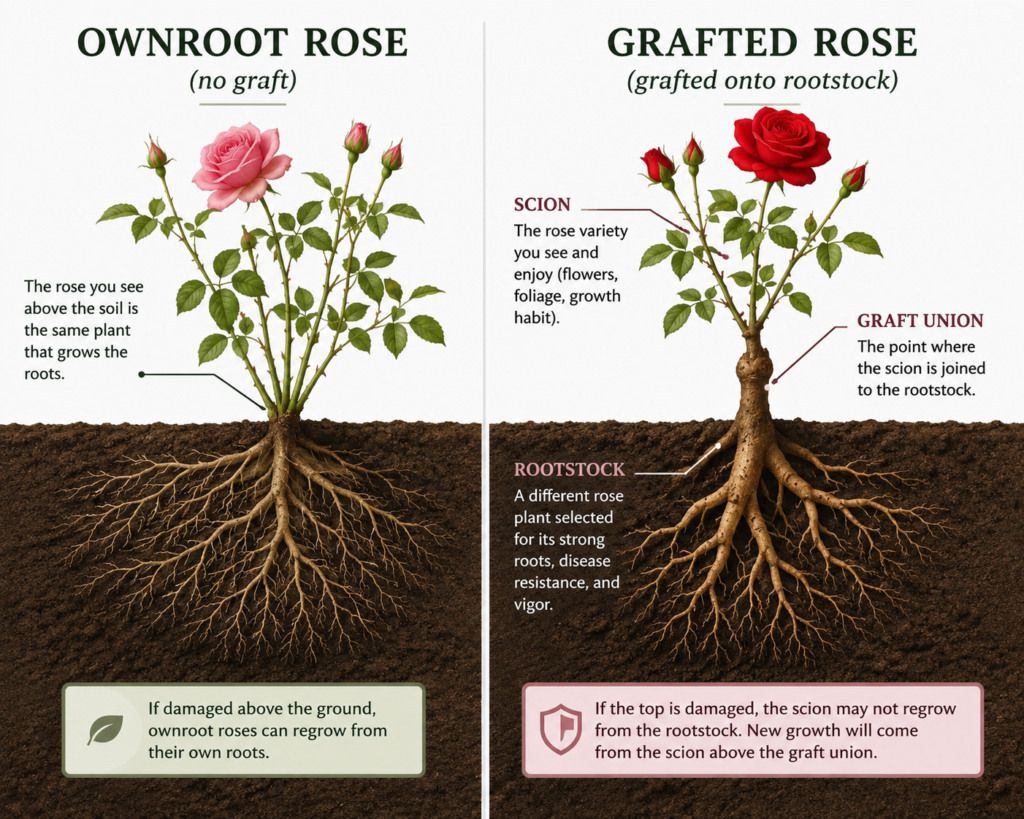
As rose gardeners continue to expand our knowledge — and as new rose vendors continue to enter the market — it’s becoming increasingly important to understand exactly what you’re buying. One of the biggest differences between roses lies beneath the soil: the roots.
When shopping for roses, you’ll typically encounter two types: own-root roses and grafted (or budded) roses.
Own-Root Roses
An own-root rose is exactly what it sounds like—the roots and the top growth are genetically the same plant. If the rose ever dies all the way back to the ground, any new growth that emerges will always be true to that variety. There’s no concern about the plant reverting to something different.
Grafted (Budded) Roses
A grafted or budded rose is created by attaching a bud (or node) from the desired rose variety onto a separate rootstock chosen for its vigor, adaptability, or cold hardiness. The result is a plant that combines the beauty of one rose with the strengths of another’s root system.
Not all rootstocks are created equal, and each has strengths that make it better suited for certain climates and soil conditions.
Dr. Huey
Best for: Arid, hot regions such as the American West and Southwest, as well as alkaline soils.
Why growers like it: Dr. Huey is the industry standard for many commercial rose growers in the United States. It develops a deep, vigorous root system, grows quickly, and performs well in the compacted clay soils commonly found in newer subdivisions.
Multiflora
Best for: Cold-winter climates and acidic, moist, or heavy clay soils, making it an excellent choice for much of the Midwest and Northeast.
Why growers like it: Multiflora is extremely cold-hardy and very vigorous. However, it does not perform well in alkaline soils.
Laxa
Best for: Cool, temperate climates and chalky or alkaline soils.
Why growers like it: Laxa is widely used throughout the United Kingdom because it thrives in cooler environments, is easy for propagators to work with, and generally produces fewer rootstock suckers. It is not commonly available in the United States.
Fortuniana
Best for: Tropical and humid climates with sandy, nutrient-poor soils, such as Florida and the U.S. Gulf Coast.
Why growers like it: Fortuniana is highly resistant to root-knot nematodes and produces exceptionally vigorous, long-lived plants with impressive bloom size. Because it has a relatively shallow root system, it is not winter hardy and is generally recommended only for USDA Zones 7–11.
Why Buy a Grafted Rose Instead of an Own-Root Rose?
It’s a question many gardeners ask: If own-root roses grow back true to variety, why buy a grafted rose?
The answer is simple—not every rose thrives on its own roots.
Some varieties simply aren’t vigorous enough to perform well without assistance. Grafting them onto a stronger rootstock gives them the vigor they need to establish more quickly, grow more robustly, and produce better flowers. In fact, some rose varieties are only available as grafted plants because they perform poorly on their own roots.
What Works Best in Columbus, Ohio?
For those of us gardening in Columbus, Ohio, we’re fortunate to have options. Both own-root roses and grafted roses perform well here. The two rootstocks you’ll most commonly encounter—and that are well-suited to our climate—are Dr. Huey and Multiflora.
Understanding the differences between rootstocks allows you to choose roses that are best adapted to your garden’s soil, climate, and growing conditions. While the blooms above ground may look identical, what’s happening below the surface can make all the difference in the long-term health and performance of your rose.